I didn't really understand the Treaty of Brest-Litovsk so if you may add something?
Today we received a packet that basically detailed the reasons that America had joined the first World War, then known as the Great War.
The first page was a declaration from Wilson, President at that time, announcing to Congress and the World that the United States should and will remain neutral in the war. He claimed that the American spirit (Nationalism) is to remain neutral no matter what side one believes is correct. A loss of neutrality would result in divisions amongst the people.
The second page was a news article in the London Times in which a British ship was sunk by a German Submarine. The ship was named the Lusitania; hundreds of the passengers were American that had died in the attack. This was one cause in the U.S. joining the war. It was necessary to protect the lives of Americans, and Germany had attacked them. I’m not sure if this is correct but, I believe this is similar to when Germany had invaded Belgium, a neutral nation. Germany had basically attacked a neutral country, the U.S. This attack will force the Americans to react in some manner.
Another document was a letter from Germany to an embassy in Mexico. Germany wanted Mexico as an ally to their cause because their borders were close to the U.S. If Mexico agreed to fight America then they would receive land and money as art of the spoils of war. Mexico had lost Texas, New Mexico and Arizona to the U.S. within the past 100 years and was eager to gain that territory back. The U.S> obviously does not like this and is “another strike” against Germany.
Lastly, Russia surrendered the war. Russia was under a lot of pressure and was also losing, so it was decided that it should basically “step out.” If the war is won by the Allies, then Russia won’t receive that many benefits. This blog says it all!
The next to blog will be Romi!
First set of questions are due tomorrow!
Thursday, March 25, 2010

Wednesday, March 24, 2010
Tyler said 3/24...
Hello Mrs. Separ. So today's class started with an around of applause for Mrs. Separ. After that ended, Mrs. Separ took a survey of who was going to be borrowing AP books from the school. After that we were given massive packets which go along with the books we will be given or purchasing for the AP exam. THey looked quite lengthy and a lot of questions in them. After we received them Mrs. Separ told us about how April was going to be a very tough month but if you work hard you it will pay off on the AP exam. We also learned of the optional AP exam being given on April 30 after school. Lastly, we were given a break assignment based on the role of women in their society due when we get back. We were assigned an area in class.
As for the lesson, we continued to learn about WWI. We reviewed from yesterday about MAIN militarism, alliances, imperialism, and nationalism which were the main causes of WWI. We also went over the alliances during the war the triple entente which were Russia, France, and Great Britain and the triple alliance which was Germany, Austria-Hungary, and the Ottoman Turks. We learned that the war began with the assassination of the heir to Austria who was Prince Ferdinand. This made Austria declare war on serbia which set everything else into motion. This caused Russia to support Serbia due to their cultural similarities, which lead to Germany backing up their ally Austria. And then being the bad ass that Germany was they declared war on Russia's ally France. Then we learned of how Great Britain was not involved until Germany ignored their letter saying not to invade France through the neutral country of Belgium. After they ignored this Great Britain declared war on Germany. This is what we basically got up to. Lastly, we learned of how the colonies in other parts of the world like Africa fought with one another as well. Showing how this was truly a world war.
At the end of class we received a map which needs to be filled in for homework based on this time in the textbook. We also have the second set of textbook questions due on friday as well. AS for the next blogger it will be Alex Hinners.
Alex--please blog tomorrow night even if I am still at the blood drive, thanks.
As for the lesson, we continued to learn about WWI. We reviewed from yesterday about MAIN militarism, alliances, imperialism, and nationalism which were the main causes of WWI. We also went over the alliances during the war the triple entente which were Russia, France, and Great Britain and the triple alliance which was Germany, Austria-Hungary, and the Ottoman Turks. We learned that the war began with the assassination of the heir to Austria who was Prince Ferdinand. This made Austria declare war on serbia which set everything else into motion. This caused Russia to support Serbia due to their cultural similarities, which lead to Germany backing up their ally Austria. And then being the bad ass that Germany was they declared war on Russia's ally France. Then we learned of how Great Britain was not involved until Germany ignored their letter saying not to invade France through the neutral country of Belgium. After they ignored this Great Britain declared war on Germany. This is what we basically got up to. Lastly, we learned of how the colonies in other parts of the world like Africa fought with one another as well. Showing how this was truly a world war.
At the end of class we received a map which needs to be filled in for homework based on this time in the textbook. We also have the second set of textbook questions due on friday as well. AS for the next blogger it will be Alex Hinners.
Alex--please blog tomorrow night even if I am still at the blood drive, thanks.
Friday, March 19, 2010
David said 3/18...
Sorry it was posted late. My cable went out last night, no internet service. Separ
Hello Mrs Separ, I walked into calss today and the "r" in Eddie's stick thing fell over, so he and Mehlman decided to fix it with some tape. When we finally sat down and got settled, we continued learning about the Ottoman Empire and their collapse. We starte with Mahmud II, who realized that he needed to modernize. He needed to rebuild the military, but he wanted to prevent the Jannisaries from rebeling. So e came up with the plan of getting his own army and training them with modern ways. He then tells the Jannisaries, who rebel like he predicted, and his troops fight the Jannisaries. He also Europeanized the army, made schools secular, and made telegraph lines. The empire shrunk, but it was the most stable since the 1600's. Mahmud ruled from 1808-1839. Here is where the Tazimat Era begins, what were some reforms?
We then learned about Abdul Hamid II, who ruled from 1876- 1909. He originally accepted the constitution in place, but then he turned around and suspends the constitution, disbands the parlaiment, and kills people who speak out against him.He did, though, continue to reform education and the military. Mrs. Separ then put up the slide of the Young Turks. I made a comment that it is a famous Rod Stewart song. Mrs. Separ said that she coudn't stand Rod, still can't. I was kind of upset about that, but The Young Turks eventually stage a coup and overthrow him in 1909. What did the Young Turks want? What about their proclamation? They put Rashid in power who ruled from 1909- 1918. He was only a puppet ruler who took orders from the Young Turks. ROD IS G-D!!!!
David forgot to pick the next blogger...it is Tyler
Hello Mrs Separ, I walked into calss today and the "r" in Eddie's stick thing fell over, so he and Mehlman decided to fix it with some tape. When we finally sat down and got settled, we continued learning about the Ottoman Empire and their collapse. We starte with Mahmud II, who realized that he needed to modernize. He needed to rebuild the military, but he wanted to prevent the Jannisaries from rebeling. So e came up with the plan of getting his own army and training them with modern ways. He then tells the Jannisaries, who rebel like he predicted, and his troops fight the Jannisaries. He also Europeanized the army, made schools secular, and made telegraph lines. The empire shrunk, but it was the most stable since the 1600's. Mahmud ruled from 1808-1839. Here is where the Tazimat Era begins, what were some reforms?
We then learned about Abdul Hamid II, who ruled from 1876- 1909. He originally accepted the constitution in place, but then he turned around and suspends the constitution, disbands the parlaiment, and kills people who speak out against him.He did, though, continue to reform education and the military. Mrs. Separ then put up the slide of the Young Turks. I made a comment that it is a famous Rod Stewart song. Mrs. Separ said that she coudn't stand Rod, still can't. I was kind of upset about that, but The Young Turks eventually stage a coup and overthrow him in 1909. What did the Young Turks want? What about their proclamation? They put Rashid in power who ruled from 1909- 1918. He was only a puppet ruler who took orders from the Young Turks. ROD IS G-D!!!!
David forgot to pick the next blogger...it is Tyler
Tuesday, March 9, 2010
Nick said 3/9...
Dear Ms Separ,
Today we started off class by discussing our homework from last night. That was the comparing of the Treaties of Nanking and Kanagawa. There were many differences and similarities that we mentioned but I won't get into them all. But some of the most important ones was that they were similar because they both opened up trade in previously isolated countries. Also they were different because of the fact that the Treaty of Nanking didn't involve the Chinese at all and the Treaty of Kanagawa was more of an agreement between Japan and the United States.
Now onto the lesson today. We stuck with Japan moving into Meiji Japan where they were much more supportive of the western ideas than the Tokogawa were. But even with the much larger support, there were still many people that opposed the idea of adopting western culture as shown by the picture we saw today with the bearded midget. I don't remember the name of it but whatever. After that we moved onto breaking up into groups and went over 11 documents about Meiji Japan and their more western and industrialized look. All 11 documents seemed to be pretty positive toward these changes. i mean besides the fact that some didn't really appreciate the western dress style, everything was positive. Some examples of this were how in document 9 when a Japanese army major stated his extreme pleasure in the new changes. The Japanese Emperor was also very supportive of the new culture as shown in document 4 where he is shown in a European style painting nothing like the usual paintings of the Japanese and probably done by a European. The new ways also helped Japan expand and grow outward and more inland then there off-coast country.
That's pretty much what we did today. I hope it helped and don't forget that we have the back of that worksheet due tomorrow and that our take home quiz thing is due on Friday. Next blogger gonna be David. pce
Today we started off class by discussing our homework from last night. That was the comparing of the Treaties of Nanking and Kanagawa. There were many differences and similarities that we mentioned but I won't get into them all. But some of the most important ones was that they were similar because they both opened up trade in previously isolated countries. Also they were different because of the fact that the Treaty of Nanking didn't involve the Chinese at all and the Treaty of Kanagawa was more of an agreement between Japan and the United States.
Now onto the lesson today. We stuck with Japan moving into Meiji Japan where they were much more supportive of the western ideas than the Tokogawa were. But even with the much larger support, there were still many people that opposed the idea of adopting western culture as shown by the picture we saw today with the bearded midget. I don't remember the name of it but whatever. After that we moved onto breaking up into groups and went over 11 documents about Meiji Japan and their more western and industrialized look. All 11 documents seemed to be pretty positive toward these changes. i mean besides the fact that some didn't really appreciate the western dress style, everything was positive. Some examples of this were how in document 9 when a Japanese army major stated his extreme pleasure in the new changes. The Japanese Emperor was also very supportive of the new culture as shown in document 4 where he is shown in a European style painting nothing like the usual paintings of the Japanese and probably done by a European. The new ways also helped Japan expand and grow outward and more inland then there off-coast country.
That's pretty much what we did today. I hope it helped and don't forget that we have the back of that worksheet due tomorrow and that our take home quiz thing is due on Friday. Next blogger gonna be David. pce
Robbie said 3/8
Today in class we learned about Japan in the period 1750-1914.
Beforehand, however, we talked about some events that occurred prior to
this period. In 1540, the Portuguese brought to Japan both guns and
Christianity, and the Japanese government didn't approve of the foreign
interference. In 1600, the Tokugawa Shogunate came into power, unifying
Japan and isolating the country except for some contact with the Dutch
and Chinese. In 1640, the Pax Tokugawa was established, which brought
peace, prosperity, and stability, ultimately producing a Golden Age in
Japan. However, in 1853, Matthew Perry, an American Commodore, showed
up with three ships and a letter from President Fillmore to the
emperor of Japan. Perry brought with him a translator, artist, and
photographer, and had done a great deal of research before setting out
to Japan.
The letter, written by President Fillmore, encompassed his feelings
about how the Japanese-American relationship should be, and what the
relationship would entail in the future. He starts off by addressing
the emperor as, "Great and Good Friend," which right away shows us that
he's approaching the emperor of Japan with a desire to start off on
good terms. A little ways into the letter, Fillmore mentions friendship
once again, and goes on to talk about his wish for the two nations to
engage in commerce. He says that the U.S. will not disturb the Japanese
religiously or politically, and that because the U.S. wants Japanese
products and Japan could use those from the U.S., both countries would
benefit from the trade. He also mentions that he's aware of the strict
laws regarding foreign contact, but that change is good and definitely
possible. He tells the emperor that Japan can experiment with the
change and, if unhappy, can change back to the way it used to be with
its strict policies. Further into the letter, Fillmore says that the
Japanese should leave the U.S. sailors, who had crashed on the shores
of Japan, alone because the U.S. will provide them with the help they
need. (The reason Fillmore talks about this is because some sailors had
previously been taken hostage and abused when the U.S. ships had been
shipwrecked.) After this, the U.S. President says that he wants
refueling stations, one or two convenient ports where the U.S. can stop
by to pick up the supplies they need and had just run out of. Finally,
in summing up the letter, President Fillmore says that his four major
aspirations are friendship, commerce, a supply of coal and provisions,
and protection for his shipwrecked people. He also says that he hopes
the imperial government will accept the presents brought over by
Matthew Perry. (Perry goes over with miniature models of guns, ships,
railroads, etc.)
After talking about the letter, we learned that the U.S. gave Japan
one year to decide whether or not they would accept the terms of this
relationship. In 1854, Matthew Perry went back to Japan, this time with
a fleet of ships known as the "Black Fleet," and blocked the harbor so
no ships could come in or go out. With Perry demanding an answer, the
Japanese emperor chose that the Japanese would accept the terms
discussed in Fillmore's letter. Upon this decision, the treaty between
the U.S. and Japan, Kanagawa, was created on March 31st, 1854.
This is everything we talked about in class today, minus one other
thing. We also compared the letter written by Fillmore to that written
by the emperor of China to King George III. We said that the two
letters are opposite one another because the Chinese emperor told King
George III with stern feelings that his country wants nothing from
Great Britain, while President Fillmore tells the Japanese emperor, in
a very amiable tone, that he wants the two countries to be friendly,
and that both nations could benefit economically from one another.
I hope this helps everyone out! The next person to blog will be Nick.
Beforehand, however, we talked about some events that occurred prior to
this period. In 1540, the Portuguese brought to Japan both guns and
Christianity, and the Japanese government didn't approve of the foreign
interference. In 1600, the Tokugawa Shogunate came into power, unifying
Japan and isolating the country except for some contact with the Dutch
and Chinese. In 1640, the Pax Tokugawa was established, which brought
peace, prosperity, and stability, ultimately producing a Golden Age in
Japan. However, in 1853, Matthew Perry, an American Commodore, showed
up with three ships and a letter from President Fillmore to the
emperor of Japan. Perry brought with him a translator, artist, and
photographer, and had done a great deal of research before setting out
to Japan.
The letter, written by President Fillmore, encompassed his feelings
about how the Japanese-American relationship should be, and what the
relationship would entail in the future. He starts off by addressing
the emperor as, "Great and Good Friend," which right away shows us that
he's approaching the emperor of Japan with a desire to start off on
good terms. A little ways into the letter, Fillmore mentions friendship
once again, and goes on to talk about his wish for the two nations to
engage in commerce. He says that the U.S. will not disturb the Japanese
religiously or politically, and that because the U.S. wants Japanese
products and Japan could use those from the U.S., both countries would
benefit from the trade. He also mentions that he's aware of the strict
laws regarding foreign contact, but that change is good and definitely
possible. He tells the emperor that Japan can experiment with the
change and, if unhappy, can change back to the way it used to be with
its strict policies. Further into the letter, Fillmore says that the
Japanese should leave the U.S. sailors, who had crashed on the shores
of Japan, alone because the U.S. will provide them with the help they
need. (The reason Fillmore talks about this is because some sailors had
previously been taken hostage and abused when the U.S. ships had been
shipwrecked.) After this, the U.S. President says that he wants
refueling stations, one or two convenient ports where the U.S. can stop
by to pick up the supplies they need and had just run out of. Finally,
in summing up the letter, President Fillmore says that his four major
aspirations are friendship, commerce, a supply of coal and provisions,
and protection for his shipwrecked people. He also says that he hopes
the imperial government will accept the presents brought over by
Matthew Perry. (Perry goes over with miniature models of guns, ships,
railroads, etc.)
After talking about the letter, we learned that the U.S. gave Japan
one year to decide whether or not they would accept the terms of this
relationship. In 1854, Matthew Perry went back to Japan, this time with
a fleet of ships known as the "Black Fleet," and blocked the harbor so
no ships could come in or go out. With Perry demanding an answer, the
Japanese emperor chose that the Japanese would accept the terms
discussed in Fillmore's letter. Upon this decision, the treaty between
the U.S. and Japan, Kanagawa, was created on March 31st, 1854.
This is everything we talked about in class today, minus one other
thing. We also compared the letter written by Fillmore to that written
by the emperor of China to King George III. We said that the two
letters are opposite one another because the Chinese emperor told King
George III with stern feelings that his country wants nothing from
Great Britain, while President Fillmore tells the Japanese emperor, in
a very amiable tone, that he wants the two countries to be friendly,
and that both nations could benefit economically from one another.
I hope this helps everyone out! The next person to blog will be Nick.
Thursday, March 4, 2010
Connelly said 3/4....
Sorry for the lateness. Alas, these rehearsals have been the death of me. This is the blog for yesterday and today. So yesterday, March third, we reviewed a great deal about the Treaty of Nanking. The Chinese referred to this treaty as the unqual treaty, because it forced the Chinese to give money, Hong Kong, and the rights of extraterritoriality. Then, we learned about the Opium Wars, the first time we see the British in a militaristic light in China. The Chinese were frustrated by the British, who pumped opium into China. This war was resolved by the Treaty of Nanking. Then came the spheres of influence in China, which were large pieces of land that foreign powers controlled. This control, however, was entirely economic. Still, this cut deeply into China, and the U.S. becme scared so they established an Open Door Policy in China where they could trade wherever they wanted. Eventually, in 1911, the Qing Dynasty abdicates thier power. But why, other than these reasons, did China fall? Today, thats what we learned about. We went over our readings that we had read and noted, about The Taiping Rebellion, Self Strengthening Movement, and Boxer Rebellion. These issues all led to the Qing downfall. The first, the Taiping Rebellion, had to do with a militaristic and religious sect that gained some power. The next was another failed attempt at control over China, as they tried to make Westernization and throw back to Confucian ideas occur at the same time, which is a great idea, but it lacked support. The last attempt at control was by the terrosit Boxer group, who attempted to fight the foreginers and get them out. These were all failed attempts, and all lakced the support of the Qing. We left off by receiveing readings about the women of China, after reading about the challenges of Emperor Puyi, adivsing him, and then learning about Sun Yat-sen, who established Chinese republic. The next to blog will be Robby Rosen. Please look over my post from last night as well.
Wednesday, March 3, 2010
Tiffany said 3/2...
Hi Mrs separ sorry this is so late my email literally hasnt been working the whole day. I was actually about to make a new email address to get this to you, and in the process figured out what was wrong. So, sorry again.
Today in class we spoke about the Opium wars. We started by speaking about Britain's interest in Chinese trade and how they had been denied access for a long time. Then we saw a beautifully made slide show about the origins of opium. Mrs. Separ explained how opium was used as early as in the civilization of Mesopotamia, where it was considered a joy plant and of great use in their religion. We saw that people considered opium to be a great plant that could heal sickness and relieve pain. We all commented on the woman giving her child opium cough syrup to shut it up and help it not feel as much pain when it was teething, and the fact that Mrs. Separ said she would do the same thing with her twins. Adults also used opium in medicines, and one in particular contained the word heroin in its name. Mrs. Separ explained that heroin and opium are similar in that they are very physically addicting. The Chinese got so addicted to this drug when it was introduced by the British, that they even set up opium dens, which are comparable to teahouses in that they were just places where you could sit, relax, and smoke. 90% of the Chinese population was addicted to opium, and this wasn't only the poor, uneducated people, but also the rich rulers of government. The Chinese administration could not stand this and decided to go to war with Britain, who refused to withdraw their opium business. This created the opium wars, which lasted from 1839 to 1842. The British was much stronger than the Chinese because of their use of gunpowder and their advanced navy, while the Chinese only used swords. The British signed the Treaty of Nanjing, and there were no Chinese representatives present, which is why the Chinese called it the "unequal treaty." The British were given many rights in China such as the extraterritoriality, which means that a British man living in China was subject to British laws, not those of the Chinese. The British had a blatant disregard for the customs of the Chinese, and their well being.
The next person to blog will be Connelly
Today in class we spoke about the Opium wars. We started by speaking about Britain's interest in Chinese trade and how they had been denied access for a long time. Then we saw a beautifully made slide show about the origins of opium. Mrs. Separ explained how opium was used as early as in the civilization of Mesopotamia, where it was considered a joy plant and of great use in their religion. We saw that people considered opium to be a great plant that could heal sickness and relieve pain. We all commented on the woman giving her child opium cough syrup to shut it up and help it not feel as much pain when it was teething, and the fact that Mrs. Separ said she would do the same thing with her twins. Adults also used opium in medicines, and one in particular contained the word heroin in its name. Mrs. Separ explained that heroin and opium are similar in that they are very physically addicting. The Chinese got so addicted to this drug when it was introduced by the British, that they even set up opium dens, which are comparable to teahouses in that they were just places where you could sit, relax, and smoke. 90% of the Chinese population was addicted to opium, and this wasn't only the poor, uneducated people, but also the rich rulers of government. The Chinese administration could not stand this and decided to go to war with Britain, who refused to withdraw their opium business. This created the opium wars, which lasted from 1839 to 1842. The British was much stronger than the Chinese because of their use of gunpowder and their advanced navy, while the Chinese only used swords. The British signed the Treaty of Nanjing, and there were no Chinese representatives present, which is why the Chinese called it the "unequal treaty." The British were given many rights in China such as the extraterritoriality, which means that a British man living in China was subject to British laws, not those of the Chinese. The British had a blatant disregard for the customs of the Chinese, and their well being.
The next person to blog will be Connelly
Thursday, February 25, 2010
Amanda said 2/25...
Today in class we reviewed what we learned yesterday about the Panama Canal. Then we learned that Roosevelt added a new document to the Monroe Doctrine, called the Roosevelt Corollary. It stated that we had the right to be the police force in North and South America and we will pay off the debts of those places. If other countries didn't follow the rules, we had the right to attack them. By this time, it was 1904 and the U.S. had grown and become strong, therefore this document added the "muscle" to the Monroe Doctrine, and we were able to back it up.
We then moved on to imperialism in China. We reviewed the dynasties starting from the very first one (even though it was never proven to exist). It started off with the Xia, then the Shang dynasty, who were the first to monopolize bronze, then the Zhou dynasty, the first to enforce the mandate of heaven and the dynastic cycle. Next, there was the Qin dynasty, led by Shi Huangdi, and they were very strict legalists. The Han dynasty came next, and they can be compared to Rome. They were the classical and Golden Age of China, and silk and paper were invented during that dynasty. The Tang and Song dynasties were next, and they were also 2 Golden Ages. The Song dynasty was full of big cities and very cosmopolitan. The next dynasties were the Yuan, who were Mongols, and the Ming, who were very interested in starting, and ending exploration. That brought us to the last dynasty in China that was called the Qing, but they are also know as the Manchu. They existed from 1644-1911.
During the 1500's (Ming Dynasty), Europe started to push into China, mostly for their natural resources and convenient location. The Ming was unhappy with this, so they isolated their country and created strict laws that foreign countries had to follow in order to come in. They were able to do this because they were much stronger than any other place at the time. These policies carried over to the Qing dynasty.
In the beginning, the Qing was extremely stable, with fair laws, civil service exams, and great agriculture. They became obsessed with politics, and payed no attention to the economic and technnological problems they were facing. By 1715, China experienced a horrible famine and the government did little to help. We looked at woodblocks that showed the harsh conditions and the devastating effects of the famine. People had nothing, and China was faced with two main problems that the government needed to address:
1. unhappy people at home due to famine,
&
2. foreigners pushing into their country.
The "pushiest" country at this time was Great Britan. They didn't use guns, a navy, and they try to be nice, but when they don't get their way they change all of that. The laws that the Ming had set about who trade had gone down the drain because the Qin dynasty wasn't as strong as the Ming were, and the rest of the world became much stronger.
After that, we moved on to the sheets that we have to finish for homework, and textbook assignment number 5A is due tomorrow as well. We will also probably have a big test around March 8th.
The next person to blog is Tiffany!
We then moved on to imperialism in China. We reviewed the dynasties starting from the very first one (even though it was never proven to exist). It started off with the Xia, then the Shang dynasty, who were the first to monopolize bronze, then the Zhou dynasty, the first to enforce the mandate of heaven and the dynastic cycle. Next, there was the Qin dynasty, led by Shi Huangdi, and they were very strict legalists. The Han dynasty came next, and they can be compared to Rome. They were the classical and Golden Age of China, and silk and paper were invented during that dynasty. The Tang and Song dynasties were next, and they were also 2 Golden Ages. The Song dynasty was full of big cities and very cosmopolitan. The next dynasties were the Yuan, who were Mongols, and the Ming, who were very interested in starting, and ending exploration. That brought us to the last dynasty in China that was called the Qing, but they are also know as the Manchu. They existed from 1644-1911.
During the 1500's (Ming Dynasty), Europe started to push into China, mostly for their natural resources and convenient location. The Ming was unhappy with this, so they isolated their country and created strict laws that foreign countries had to follow in order to come in. They were able to do this because they were much stronger than any other place at the time. These policies carried over to the Qing dynasty.
In the beginning, the Qing was extremely stable, with fair laws, civil service exams, and great agriculture. They became obsessed with politics, and payed no attention to the economic and technnological problems they were facing. By 1715, China experienced a horrible famine and the government did little to help. We looked at woodblocks that showed the harsh conditions and the devastating effects of the famine. People had nothing, and China was faced with two main problems that the government needed to address:
1. unhappy people at home due to famine,
&
2. foreigners pushing into their country.
The "pushiest" country at this time was Great Britan. They didn't use guns, a navy, and they try to be nice, but when they don't get their way they change all of that. The laws that the Ming had set about who trade had gone down the drain because the Qin dynasty wasn't as strong as the Ming were, and the rest of the world became much stronger.
After that, we moved on to the sheets that we have to finish for homework, and textbook assignment number 5A is due tomorrow as well. We will also probably have a big test around March 8th.
The next person to blog is Tiffany!
Wednesday, February 24, 2010
Coery said 2/24
Hello fellow classmates and Ms. Separ!
Today's date is Febuary 24th and I will share the information I recieved with the class.
Today's topic brought us back to 8th grade, where we learned about the United States and its interaction with the world.
In 1796 our first president (under the Consistution, before him were seven others) read aloud his farewell address in which he urged America to never get involved in foregin affairs. Pardon my French (Connally would call that racist), but that idea went down the shitter a couple of years later. :P Is that really French?
In 1823 James Monroe did the only one thing in his carrer - created the Monroe Doctrine. The document read, and I paraphrase, no other European country will meddle with the Americas or they will experience bodily harm; however, we will not bother the European countries. Basically, America told Europe to back off with a swithblade while Europe has a gun to America's head, but it wasn't all a stupid doctrine. At the time, Spain had it's eyes set on Latin America and America knew that the British and the Americas did not want Spain to take over Latin America, so America made themselves look tough by not mentioning that the British would help them. It sound like one of those dramatic scenes in an action movie that have people pointing guns at two different people at the same time. Bad example, but it works. :P
In 1845 now America plays the God card ("The power of Christ compels you") to explain why it wants to spread it's territories from coast to coast, because it was their "devine mission" to do so. The American people were so obbsesed with this idea that they called it the Manifest Destiny. So America simply said that God told them to murder some Natives and unreasonably slaughter thousands of bison. So we learned that in 1845, America had a streak of schizophrenia. :P
In 1846 there was a little war with Mexico and America. America won, and in return it got New Mexico and California. However, America tried not to act like a grime and gave Spain $15,000,000. US tried to act like a good country and not like a complete jerk like their pal Europe but it still failed. :P
In the 1890's America felt like taking over some of the islands in the pacific for the same reasons as Europe but capitalized the fact that they wanted to make money. One can relate this to the dutch colonies in the pacific back in the 1450's to 1750's period. Ha, I'm smart. :P
I think I forgot something interesting. Oh yeah, that stuff with Cuba and that stuff with pinapples in Hawaii. Give me a break. We'll start with Hawaii first. Why? Because I like Pinapples. :P
In the early 1800's there was some influence of Americas in the islands of Hawaii, except there were missonaries with nothing to do then to harrass the crap out of you about God, like Yankee fans with baseball. That all change due to one person called Mr. Dole. He went to Hawaii to grow pineapples. He made so much money, America told Dole to stage a coup in Hawaii. So Mr. Dole did, and he became President of Hawaii in 1894. Then he allowed America to annex him in 1898. Now you got to figure out what coup means, and I will give you one hint, and that it's not a 2-door car. :P
Oh, and America won Cuba after winning the Spanish-American war. Yeah it's tough to explain. :P
In 1904 we built the Panama Canal. we got the area around it by telling the native to revolt against Colombia and we backed Panama up. In 1999, we gave Panama back to Colombia. Ironic. :P
Next to the keyboard will be Amanda. I totally forgot if she went allready, but if she did than the next person will be David Freese. :P
Quiz: Create a change over time chart that describes US imperialism. Hand in tomorrow in class. Separ
Today's date is Febuary 24th and I will share the information I recieved with the class.
Today's topic brought us back to 8th grade, where we learned about the United States and its interaction with the world.
In 1796 our first president (under the Consistution, before him were seven others) read aloud his farewell address in which he urged America to never get involved in foregin affairs. Pardon my French (Connally would call that racist), but that idea went down the shitter a couple of years later. :P Is that really French?
In 1823 James Monroe did the only one thing in his carrer - created the Monroe Doctrine. The document read, and I paraphrase, no other European country will meddle with the Americas or they will experience bodily harm; however, we will not bother the European countries. Basically, America told Europe to back off with a swithblade while Europe has a gun to America's head, but it wasn't all a stupid doctrine. At the time, Spain had it's eyes set on Latin America and America knew that the British and the Americas did not want Spain to take over Latin America, so America made themselves look tough by not mentioning that the British would help them. It sound like one of those dramatic scenes in an action movie that have people pointing guns at two different people at the same time. Bad example, but it works. :P
In 1845 now America plays the God card ("The power of Christ compels you") to explain why it wants to spread it's territories from coast to coast, because it was their "devine mission" to do so. The American people were so obbsesed with this idea that they called it the Manifest Destiny. So America simply said that God told them to murder some Natives and unreasonably slaughter thousands of bison. So we learned that in 1845, America had a streak of schizophrenia. :P
In 1846 there was a little war with Mexico and America. America won, and in return it got New Mexico and California. However, America tried not to act like a grime and gave Spain $15,000,000. US tried to act like a good country and not like a complete jerk like their pal Europe but it still failed. :P
In the 1890's America felt like taking over some of the islands in the pacific for the same reasons as Europe but capitalized the fact that they wanted to make money. One can relate this to the dutch colonies in the pacific back in the 1450's to 1750's period. Ha, I'm smart. :P
I think I forgot something interesting. Oh yeah, that stuff with Cuba and that stuff with pinapples in Hawaii. Give me a break. We'll start with Hawaii first. Why? Because I like Pinapples. :P
In the early 1800's there was some influence of Americas in the islands of Hawaii, except there were missonaries with nothing to do then to harrass the crap out of you about God, like Yankee fans with baseball. That all change due to one person called Mr. Dole. He went to Hawaii to grow pineapples. He made so much money, America told Dole to stage a coup in Hawaii. So Mr. Dole did, and he became President of Hawaii in 1894. Then he allowed America to annex him in 1898. Now you got to figure out what coup means, and I will give you one hint, and that it's not a 2-door car. :P
Oh, and America won Cuba after winning the Spanish-American war. Yeah it's tough to explain. :P
In 1904 we built the Panama Canal. we got the area around it by telling the native to revolt against Colombia and we backed Panama up. In 1999, we gave Panama back to Colombia. Ironic. :P
Next to the keyboard will be Amanda. I totally forgot if she went allready, but if she did than the next person will be David Freese. :P
Quiz: Create a change over time chart that describes US imperialism. Hand in tomorrow in class. Separ
Wednesday, February 10, 2010
Mitchell said 2/8...
Ok so to start off, NO SCHOOL TOMORROW!!!!!! We all needed this day even though we have off in two more days anyway. Ok so yesterday we began class with everyone receiving a sheet on a part of technology that helped to advance and maintain imperialism. After we received the packet Connelly was yelled at for talking and annoying the class as usual. Then we went over the motives for new imperialism. the new imperialism occurs over Africa, Asia, and India. The motives were for economic, social Darwanistic, political, social gains and for the gain of natural resources. We mainly spoke about why the European nations were going to Africa in search of new colonies. The west coast of Africa is was a place easily accessible for the traders and made trading to Americas easier then the Eastern coast. Dr. David Livingstone was the first to go beyond the coastal regions and venture into the heart of Africa. He went in and wasn't heard from for close to 15 years then miraculously found in a small village by H.M. Stanley. The successful voyage into the heartland led to almost all European countries scrambling to gain colonies in Africa. Otto von Bismarck decided since he wasn't benefiting from the colonization to hold a conference in Berlin later to be know as The Berlin Conference, which set up guidelines for colonizations in Africa.
The rules were
You must plant Your flag in name of the mother country.
You must have effective occupation in the area you are claiming.
You must set up borders.
The Berlin Conference led to the Scramble for Africa.
After this conference, all countries rush to gain the colonies by setting upon setting up the rules for colonization. Lastly there were 2 types of control set up; direct and indirect. Direct was when the European nation put a person from their country in charge while indirect was when Europeans controlled the government but a native was still technically holding office so that the people would believe them easier. Technology readings are due tomorrow. ESSAY WILL BE IN CLASS ON FRIDAY, NO MATTER WHAT HAPPENS WITH THE WEATHER!
That's basically all we did yesterday and so next to go will Corey.
The rules were
You must plant Your flag in name of the mother country.
You must have effective occupation in the area you are claiming.
You must set up borders.
The Berlin Conference led to the Scramble for Africa.
After this conference, all countries rush to gain the colonies by setting upon setting up the rules for colonization. Lastly there were 2 types of control set up; direct and indirect. Direct was when the European nation put a person from their country in charge while indirect was when Europeans controlled the government but a native was still technically holding office so that the people would believe them easier. Technology readings are due tomorrow. ESSAY WILL BE IN CLASS ON FRIDAY, NO MATTER WHAT HAPPENS WITH THE WEATHER!
That's basically all we did yesterday and so next to go will Corey.
Thursday, February 4, 2010
Rebecca says 2/4...
Today in class we answered questions based on documents dealing with the different viewpoints on Imperialism. We then had to formulate a thesis, group the documents, and state any additional documentation, as if we were to write an actual essay. Document 1, an excerpt from “Does Colonization Pay” describes a positive outlook on Imperialism, mentioning the benefits that the colonies received from those nations that controlled them. They were given food, manufactured products, and access to schools and newspapers. Overall the colonies benefitted from advantages that came along with being a civilized society; benefits that they were incapable of obtaining on their own. Document 2, a picture of a white man being pulled in a chariot by an Asian and African worker depicted how native people were being abused by those who conquered their land.. This poor treatment of natives showed a negative outlook on Imperialism. Document 3, expressing a positive view, identifies exporters, bankers, military leaders, and missionaries as empire builders. Exporters promoted colonial markets, while bankers gave loans which supported the construction of railways and steamship lines between colonies and those nations controlling them. Military leaders believed in extending the white man’s rule over inferior races, while missionaries traveled to different places attempting to unite people under one religion.. Document 4, and African proverb, displays the Africans’ feelings about the missionaries. It expresses negative thoughts of how the whites took their land in return for their religion, an exchange in which they felt cheated. Document 5, a poem from the perspective of an African, describes how the whites abused their power as they killed and overworked the natives. The author clearly brings out the negative effects of imperialism through first hand examples of how his family had suffered. Document 6, thoughts from the perspective of a West African nationalist, responded harshly to years of colonialism. He stated that it prevented Africans from conducting their own affairs, it merged their economy with that of the ruling country, and on the whole, their civilization was demeaned. The final document, a German cartoon entitled “This is How the English Colonize” also portrays a negative attitude towards imperialism. It shows how the labor performed by the natives of colonized lands only benefited the nation that conquered them. Their work was being generated into money that went directly to the missionaries and other people who supported the takeover of their land.
The back page, although filled out differently for each person, should overall be about the different view points on imperialism, as mentioned in the historical context and task. Remember that Assignment 4 is due tomorrow, as well as emailed definitions/identifications of Cavour, Mazzini, Garabaldi, and Bismarck. Next up to blog is Mitchell!
The back page, although filled out differently for each person, should overall be about the different view points on imperialism, as mentioned in the historical context and task. Remember that Assignment 4 is due tomorrow, as well as emailed definitions/identifications of Cavour, Mazzini, Garabaldi, and Bismarck. Next up to blog is Mitchell!
Separ 2/4...
If I am not in class tomorrow, please work on writing the DBQ, using the documents from class.
Wednesday, February 3, 2010
Amanda said 2/3...
Today in class we started off by getting a sheet and an atlas. I don’t really remember what was on it but I’ll try to sum it up. The sheet went through some changes after the Congress of Vienna. Power was returned to the kings that Napoleon had overthrown. Unification was probably the result of enlightenment ideas and the Congress of Vienna. The sheet also went through new places that formed as a result of unification. Some new places that appeared were Norway, Prussia and Italy. In 1861, Italy was unified, in 1867, Austria-Hungary broke into two regions, all under one ruler, and in 1871, Germany became unified. When we handed that in, we got another sheet.
We had to make a Venn diagram comparing the unification of Germany and Italy after reading the sheet. Before being unified, Italy, unlike Germany had shared language and culture. Growing nationalism was a main reason for unification in both places, and they both started off as fragmented states. In Italy, a group called Young Italy was formed to help achieve unification. The Red Shirts were a group of people that fought against anyone who was opposed to unification. Italians received help from France in their war against Austria and they finally became unified in 1861.
There were many differences with the unification in Germany, where Prussia was the most powerful state. There was not a group that helped, one man, Otto Von Bismarck, was a main contributor to their unification. Bismarck had a theory for unifying Germany that was known as “Blood and Iron.” The blood stood for the sacrifices that the Germans had to make for unification. The iron represented the need for industrialization. Germany became unified in 1871, and that led to industrialization, imperialism and later, WW1.
Great job, on a difficult topic. Please read my blog!!!!!! Separ
That's it for today, and the next person to blog will be Rebecca.
We had to make a Venn diagram comparing the unification of Germany and Italy after reading the sheet. Before being unified, Italy, unlike Germany had shared language and culture. Growing nationalism was a main reason for unification in both places, and they both started off as fragmented states. In Italy, a group called Young Italy was formed to help achieve unification. The Red Shirts were a group of people that fought against anyone who was opposed to unification. Italians received help from France in their war against Austria and they finally became unified in 1861.
There were many differences with the unification in Germany, where Prussia was the most powerful state. There was not a group that helped, one man, Otto Von Bismarck, was a main contributor to their unification. Bismarck had a theory for unifying Germany that was known as “Blood and Iron.” The blood stood for the sacrifices that the Germans had to make for unification. The iron represented the need for industrialization. Germany became unified in 1871, and that led to industrialization, imperialism and later, WW1.
Great job, on a difficult topic. Please read my blog!!!!!! Separ
That's it for today, and the next person to blog will be Rebecca.
Separ 2/3...
Hello Everyone. I went to the doctor today and although, I am getting better, he wants me to continue to take it easy. So I guess we will give it one more day and see how I feel. I am going CRAZY not being able to do much, luckily I have my 9H midterms to keep me busy.
So today you took a little break from imperialism and looked at Italian and German unification. What you need to understand about these events is that both Italy and Germany were a bunch of small, independent states, who will in the late 1800s, become unified under one leader. We will briefly go over this when I get back but for homework, which is due FRIDAY, February 5th via email....
USING VERY DETAILED INFORMATION DEFINE/IDENTIFY the following:
1. Cavour
2. Mazzini
3. Garabaldi
4. Bismarck
So today you took a little break from imperialism and looked at Italian and German unification. What you need to understand about these events is that both Italy and Germany were a bunch of small, independent states, who will in the late 1800s, become unified under one leader. We will briefly go over this when I get back but for homework, which is due FRIDAY, February 5th via email....
USING VERY DETAILED INFORMATION DEFINE/IDENTIFY the following:
1. Cavour
2. Mazzini
3. Garabaldi
4. Bismarck
Tuesday, February 2, 2010
Mary said 2/2...
Hi guys, so as usual today was another fun filled class. To start off class, Connelly walked in fashionably late, carrying his huge cello on his back and his backpack on his stomach. After a good laugh we started the worksheet that the sub gave us. It was two readings, one which was a poem that focused on white mans burden and the other focused on black mans burden. White mans burden was when then white people felt they were superior and had a responsibility to change the "non-civilized" nations. The poem was written by a British poet and it was a response to America taking over the Philippines after the Spanish-American war. The poem further explained white mans burden and how the white should go into other nations and civilize the people, since they are seen as naive, barbaric and child-like. White people believed they're culture should be imposed on the conquered people, and their goal was to take over politically and economically. They also wanted to be seen as friendly and trying to help, and they did not want to be seen as a threat. The whites did help the conquered countries to an extent, by giving them food and helping with their sicknesses, but in the end the conquered people did not want to be changed, they liked their culture and customs as they were. The whites attempt to change these countries did not succeed because the indigenous people did not want to adapt new customs, they just wanted to stay unchanged. This poem justified European imperialism because the Europeans believed they were helping and improving mankind.
The second reading was another view of imperialism written by Edward Morel, another British journalist in the Belgian Congo. Black mans burden was basically the black people of Africa having to survive what the white people put them through. Slavery, disease, intense work, and abuse towards the people of Africa has mad their life miserable. They are obviously against imperialism since it has caused them nothing but trouble. There is no escape for the Africans, and the consequences cause not only physical effects, but it is also killing the soul and breaking their spirits. Their land has been invaded, families destroyed, and then they are put into a harsh life of slavery. Disease and climate also has a negative effect on the African people. The Europeans brought in diseases such as measles, smallpox, and syphilis and the Africans had no cures for these sicknesses. Also, the climate was very hot and dry which also led to deaths. Between the hard, intense work, diseases, hunger, and the climate Africans suffered from imperialism.
That pretty much sums it up for today so the next person to blog is Amanda...Feel better Ms. Separ
The second reading was another view of imperialism written by Edward Morel, another British journalist in the Belgian Congo. Black mans burden was basically the black people of Africa having to survive what the white people put them through. Slavery, disease, intense work, and abuse towards the people of Africa has mad their life miserable. They are obviously against imperialism since it has caused them nothing but trouble. There is no escape for the Africans, and the consequences cause not only physical effects, but it is also killing the soul and breaking their spirits. Their land has been invaded, families destroyed, and then they are put into a harsh life of slavery. Disease and climate also has a negative effect on the African people. The Europeans brought in diseases such as measles, smallpox, and syphilis and the Africans had no cures for these sicknesses. Also, the climate was very hot and dry which also led to deaths. Between the hard, intense work, diseases, hunger, and the climate Africans suffered from imperialism.
That pretty much sums it up for today so the next person to blog is Amanda...Feel better Ms. Separ
Separ's post...2/2
Happy Groundhog's Day. Did he see his shadow? Thanks to all that wished me a speedy recovery. Ok, let's get down to business. I am still out sick and hopefully will be back by the end of the week, I go back to the doctor tomorrow. Anyway, I received most of your homeworks BUT there were some of you, SEVEN to be exact that did not do it. NOT GOOD PEOPLE!!!!
Please remember that the person who is posting does not have to post until 7pm, sometimes they post earlier. I will post right after they do.
Today you examined two very opposing viewpoints about imperialism. Your homework tonight is to create a conversation between the two authors that debate the need for imperialism. Who's burden is it anyway? Email me your conversation, it should be in dialogue form.
esepar@bellmore-merrick.k12.ny.us
Please remember that the person who is posting does not have to post until 7pm, sometimes they post earlier. I will post right after they do.
Today you examined two very opposing viewpoints about imperialism. Your homework tonight is to create a conversation between the two authors that debate the need for imperialism. Who's burden is it anyway? Email me your conversation, it should be in dialogue form.
esepar@bellmore-merrick.k12.ny.us
Monday, February 1, 2010
Alex H said..2/1/10
Hey guys, I'm blogging AGAIN. You are all going to be blogging again! This probably going to be short because we only had a worksheet to do so bear with me. Connelly lets just say revealed some "personal" info to the rest of the class. He made big scene that I don't think he will ever live down, but i wont get into much detail. All I'm going to say is "You missed a good one Mrs.Separ". I don't even want to know. Anyway Mrs.Separ was absent today so we were assigned a worksheet. It was on "Imperialism." Imperialism is the political, militaristic, or economic domination of one country over another. This particular worksheet focused primarily on England. The numbered examples exemplifed why countries imperialized. For example, number four's reason was to spread Christianity. I'll just say the reasons and not go into detail with the numbers and everything. Some of the reasons were eeconomic gain, a lot of agricultural gain, good natural resources in desired country/area and once again the spread of Christianity. We also had to say how the industrial revolution let to imperialism. I thought that the industrialized countries needed more natural resources and that the countries that were industrialized had more wealth which led to the desire for more power. This is what we did today.
Make sure you read both Alex's blog and my blog (separ) too!
The next person is going to be Mary.
Make sure you read both Alex's blog and my blog (separ) too!
The next person is going to be Mary.
February 1...Separ post
Hi everyone,
Assignment 4 is due on Friday, I did not realize I had not assigned it...thanks Eddie.
So I am home sick. I had a terrible stomach virus that has somehow settled into my upper respiratory system---AWESOME! Being pregnant there is not much medicine I can take, so only time and rest will help. But as sick as I am I am still obsessed with staying on track!
We have started one of my favorite topics---Imperialism! Today you read about the motives and I SURE HOPE you were more specific than just stating economic, political,and social. You should have come up with things such as need for natural resources, new markets, spreading Christian idea, etc.
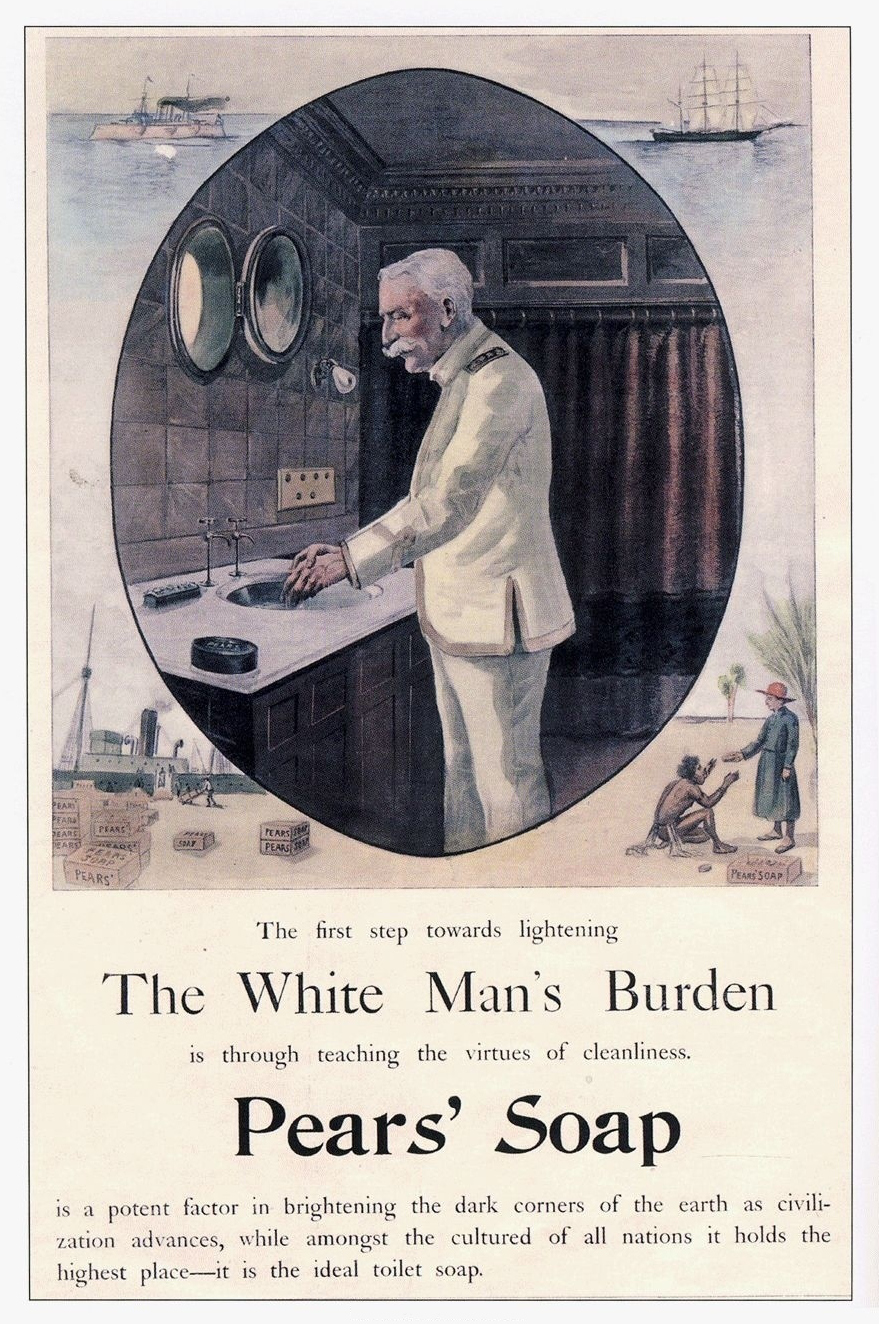
Take a look at the Pear Soap advertisement, this was an actual advertisement made in 1899. Answer the following questions and email me the answers TONIGHT by midnight my email is esepar@bellmore-merrick.k12.ny.us Make sure you also read Alex's blog. His listed above mine under archive. Click it. Also, can someone text or call Alex to remind him to read my post...thanks.
How does this advertisement support the idea of imperialism? Read the writing and look at the corners for clues. Be Specific! This homework is worth 15 points, start off 3rd quarter on the right foot!
Sunday, January 24, 2010
Margo said 1/22...
okay its my first time,(obviously) but im gona try and do a good job here.
so today Mrs. separ split us into the same groups as yesterday where we read documents about the effect of the industrial revolution. i would go into detail about yesterdays discussion but there was none. so... today we we started off by talking about cotton and how britian main source of it was the U.S. and India. later. because there was little profit, great Britain taxed than banned Indian cotton. then we talked about the documents im going to do it as if each line is a bullet point
Living conditions
there were more women working in factors
the factory owners preffered women because they did the same work as men for half the pay
because the women worked the domestic jobs were pushed to the side and children worked too
the role of women became an issue as the issue of who does the domestic jobs came forward
pollution
there were dirty, overpopulated city's
increased tenement housing without plumbing meant more waste in the streets
closer housing meant quicker spread of disease
it is where the idea of slums came from
common problems
people worked but didn't get enough to sustain their familys
almost all attempts at strike resulted in pay cuts
there was no workmans comp
worked 15-16 hours with only a 30 min break for each meal
work was very dangerous
improvements during the I.R.
later they made unions for factory workers
there was constantly better technology
the capacity of steam engines increased
life expectancy increased
there was more medicine and hospitals
other important information
as the middle class got better the lower class got worse
while life expectancy went up in Japan Russia the us and Britain it stayed the same in Africa and Asia
there is more exports from the us and gb to non-industrialised countries
britian takes over india because it is easier than paying for their natural resources
there are ,later, benefiets for workers like workmens comp
there were public health billes that specified the need for like and clean water and streets
there were vaccines that were required
there were more rail roads as the need for them arose
also the telegraph was used making comunication easier and faster
while earlier poor farmers could use wealthy mens land the enclosure acts stopped it
the people learned crop rotation
there was new farming technology
the government suported the revolution so the advancements in technology science and medicine were huge
thats about the gist of it
the next to blog will be alex please unless he already went im not to sure of all the names yet
so today Mrs. separ split us into the same groups as yesterday where we read documents about the effect of the industrial revolution. i would go into detail about yesterdays discussion but there was none. so... today we we started off by talking about cotton and how britian main source of it was the U.S. and India. later. because there was little profit, great Britain taxed than banned Indian cotton. then we talked about the documents im going to do it as if each line is a bullet point
Living conditions
there were more women working in factors
the factory owners preffered women because they did the same work as men for half the pay
because the women worked the domestic jobs were pushed to the side and children worked too
the role of women became an issue as the issue of who does the domestic jobs came forward
pollution
there were dirty, overpopulated city's
increased tenement housing without plumbing meant more waste in the streets
closer housing meant quicker spread of disease
it is where the idea of slums came from
common problems
people worked but didn't get enough to sustain their familys
almost all attempts at strike resulted in pay cuts
there was no workmans comp
worked 15-16 hours with only a 30 min break for each meal
work was very dangerous
improvements during the I.R.
later they made unions for factory workers
there was constantly better technology
the capacity of steam engines increased
life expectancy increased
there was more medicine and hospitals
other important information
as the middle class got better the lower class got worse
while life expectancy went up in Japan Russia the us and Britain it stayed the same in Africa and Asia
there is more exports from the us and gb to non-industrialised countries
britian takes over india because it is easier than paying for their natural resources
there are ,later, benefiets for workers like workmens comp
there were public health billes that specified the need for like and clean water and streets
there were vaccines that were required
there were more rail roads as the need for them arose
also the telegraph was used making comunication easier and faster
while earlier poor farmers could use wealthy mens land the enclosure acts stopped it
the people learned crop rotation
there was new farming technology
the government suported the revolution so the advancements in technology science and medicine were huge
thats about the gist of it
the next to blog will be alex please unless he already went im not to sure of all the names yet
Wednesday, January 20, 2010
Jaime said 1/19...
Today we started class by handing in our comparative essays about the revolutions. After that, Mrs. Separ gave us all a white board, an eraser and a marker. We used these to answer questions about the reading that was due about the Monroe Doctrine. We discussed that the Spanish were trying to gain back control of Latin American countries that had already gained their Independence, which threatened the US and Great Britain. The US did not want the Spanish too close to them, and they supported all the revolutions in Latin America except for the Haitian Revolution because it lead to the abolition of slavery in Haiti, and they didn't want any ideas of freedom spreading to American Slaves. The British wanted to make an alliance with the United States to warn other European powers not to try and re-colonize, because they wanted to maintain their power and control of trade. James Monroe was fine with this, but Vice President John Quincey Adams didn't like this at all because it would limit the power of the US and it would mean that the Americans would owe something to the British. However, he knew that if it really came down to it, the British would back the US because they wouldn't want Spain to get more powerful. The Monroe Doctrine states that the Western Hemisphere is closed to all European nations, that there is to be no more colonization in the Americas, and that if European countries choose to ignore these requests, then the US will have no choice but to go to war and aid the Latin American nations in remaining free. It also adds that the US will remain neutral in European affairs. Though they make this statement, the United States really doesn't have any backing on it, because they aren't that strong yet. But once again they know that the British will back them up. In the middle of this discussion, David ran to the garbage can and threw up. Mrs. Separ cheered for him because he made it to the garbage can so there was no mess. After he left the room, Mrs. Separ sprayed the room with lysol and we talked about it for a while. Everybody was pretty shocked, because it was kind of random. For tomorrow we have to answer questions on the blog and complete a worksheet.
The next person to go will be Margo.
The next person to go will be Margo.
Tuesday, January 19, 2010
Homework 1/19/10
Tonight's homework 1/19/10
1. Google Modern History Sourcebook
2. Click on first link
3. Once on the webpage go to left-hand side and click Industrial Revolution.
4. Scroll down to social and political effects
5. Read Women Miners in English coal pits
6. Read Lowell Mill Girls
****Write a summary for each reading. What insights does it give us to the Industrial Revolution.
1. Google Modern History Sourcebook
2. Click on first link
3. Once on the webpage go to left-hand side and click Industrial Revolution.
4. Scroll down to social and political effects
5. Read Women Miners in English coal pits
6. Read Lowell Mill Girls
****Write a summary for each reading. What insights does it give us to the Industrial Revolution.
Saturday, January 16, 2010
Hayley said...1/15
> It's sooo unfair that I have to do this on a Friday, but I'll
> suck it up and here is what we did today in class or at least
> what I wrote down in my notes:
>
> It all started when the ceiling started to leak and then after
> that then we talked about history, the reason we were all there:
> The king and queen's power was weakening in Spain so the
> colonies started to rebel while they were distracted
> The creoles (the lower white class that still had power but not
> a lot) out numbered the pensolares (the upper class in the colonies)
> The revolution in Latin America first started out to be about
> the creoles wanting to take the pensolares out of power and they
> wanted to be equal to them (economic rights and power)
> Then we watched an intersting cartoon with two really creapy
> looking kids in it who came in 3rd place at their science fair
> and then went back in time to Latin America:
> The kids come across the King Ferdinand and Bolivar in 1799
> compeating in a tennis contest: Bolivar wins and the King is mad
> Bolivar then tells the kids he's mad at how the king treats the
> coloniesThey organize a rebellion at Bolivar's house
> ~the soldiers would never suspect Bolivar
> to be unhappy with things because he
> was in a high power, owned land and was rich.
> Then the rebellion goes first to Venezuela, Columbia (which is
> where they fall down a purple mountain), Peru, Ecuador, Boiliva,
> and lastly Panama
> Bolivar's goal from the get go was to unite and form one Latin America
> ~they name a country after Bolivar
> No body agrees with this view and they break out into a food
> fight (aka civil war)
> Bolivar belives he is a failure amd dies in exile from his own
> personal choice
> Toussaint and Bolivar were painted like Napolean and were
> painted on horses climbing rocks(even though Napolean was really
> on an ass)
> Then we looked at the Spain articles and then lastly the Mexico
> articles Spain article is Bolivar's pep talk to the
> colonies, more specifically only, the creoles:
> They are a mixed people with a common conflict (trying to figure
> out who exactly they represent Spain, their heritage, or the
> colonies, where they live)
> They are restricted by the Spanish crown
> Bolivar is shocked that the United States Government is able to
> manage their peoples for so long and that type of government was
> not for Latin America (not ready for a democracy)
> Which is not really and enlightened way of thinking because it's
> not total equality for all of the peoples
>
> Mexican Constitution of 1824 was written by the creoles:
> Article 3 - they are restricting what religion the Mexicans can
> practiceArticle 50- they are giving the peoples freedom of press
> (irony!)Father Hidalgo organizes the peseant revolt (different
> from Bolivar because it was a lower class rebellion)
> Their revolt was, from the start, about gaining their
> independence (eco. and social welfare)
> 1820- Mexico gains independence
> 1821- Emperor is in charge (which was not what they wanted to happen)
> 1822- Establish a republic that was run by the Creoles (oh no!)
> 1824- Constitution republic sets up
> Then FINALLY as we were leaving Mrs. Separ asked us who out of
> the three rulers we talked about was the most enlightened and
> most of the class agreed that it was Toussaint. Okay the next
> person to suffer this fate is Jamie. :]
> suck it up and here is what we did today in class or at least
> what I wrote down in my notes:
>
> It all started when the ceiling started to leak and then after
> that then we talked about history, the reason we were all there:
> The king and queen's power was weakening in Spain so the
> colonies started to rebel while they were distracted
> The creoles (the lower white class that still had power but not
> a lot) out numbered the pensolares (the upper class in the colonies)
> The revolution in Latin America first started out to be about
> the creoles wanting to take the pensolares out of power and they
> wanted to be equal to them (economic rights and power)
> Then we watched an intersting cartoon with two really creapy
> looking kids in it who came in 3rd place at their science fair
> and then went back in time to Latin America:
> The kids come across the King Ferdinand and Bolivar in 1799
> compeating in a tennis contest: Bolivar wins and the King is mad
> Bolivar then tells the kids he's mad at how the king treats the
> coloniesThey organize a rebellion at Bolivar's house
> ~the soldiers would never suspect Bolivar
> to be unhappy with things because he
> was in a high power, owned land and was rich.
> Then the rebellion goes first to Venezuela, Columbia (which is
> where they fall down a purple mountain), Peru, Ecuador, Boiliva,
> and lastly Panama
> Bolivar's goal from the get go was to unite and form one Latin America
> ~they name a country after Bolivar
> No body agrees with this view and they break out into a food
> fight (aka civil war)
> Bolivar belives he is a failure amd dies in exile from his own
> personal choice
> Toussaint and Bolivar were painted like Napolean and were
> painted on horses climbing rocks(even though Napolean was really
> on an ass)
> Then we looked at the Spain articles and then lastly the Mexico
> articles Spain article is Bolivar's pep talk to the
> colonies, more specifically only, the creoles:
> They are a mixed people with a common conflict (trying to figure
> out who exactly they represent Spain, their heritage, or the
> colonies, where they live)
> They are restricted by the Spanish crown
> Bolivar is shocked that the United States Government is able to
> manage their peoples for so long and that type of government was
> not for Latin America (not ready for a democracy)
> Which is not really and enlightened way of thinking because it's
> not total equality for all of the peoples
>
> Mexican Constitution of 1824 was written by the creoles:
> Article 3 - they are restricting what religion the Mexicans can
> practiceArticle 50- they are giving the peoples freedom of press
> (irony!)Father Hidalgo organizes the peseant revolt (different
> from Bolivar because it was a lower class rebellion)
> Their revolt was, from the start, about gaining their
> independence (eco. and social welfare)
> 1820- Mexico gains independence
> 1821- Emperor is in charge (which was not what they wanted to happen)
> 1822- Establish a republic that was run by the Creoles (oh no!)
> 1824- Constitution republic sets up
> Then FINALLY as we were leaving Mrs. Separ asked us who out of
> the three rulers we talked about was the most enlightened and
> most of the class agreed that it was Toussaint. Okay the next
> person to suffer this fate is Jamie. :]
Wednesday, January 13, 2010
Brian said 1/13....
Haitian Revolution
The island of Haiti was originally called St. Domingue and became a French Colony. The colony was the richest colony in the world before 1789 as a result of large sugar production and then secondly also producing coffee. Haiti was only allowed to trade with France and so this further helped France’s economy in developing. There were 5 main social classes consisting of the slaves, free blacks, mulatos (mix of White and Black), poorer whites and white wealthy land owners. There was a system of laws that were supposed to protect slaves to some extent however they didn’t help much and the slaves still wished for equality. Some of these laws were against cruel punishment and arbitrary punishment (hurting a slave, or anyone, for the sake of hurting them). By the late 1700’s Haitian society was split between wealth and race.
Rich Whites were originally the ones to support the French Revolution because they wished to break away from France and become independent. If Haiti became its own country than they would control most of their trade, under France 50% of their crops went straight to the French Government. As time progressed the other classes began to support the Revolution for equality/ political rights which gave a chance for true freedom from slavery.
Toussaint
He was a freed slave who had been educated by his master and wished to abolish slavery in Haiti. The goal of becoming independent from France was only second to that of his main desire. From 1790-1793 there was a lot of chaos in Haiti, and in 1793 slavery was abolished.
In 1799 Toussaint gained control of the entire Island and ran it as a military dictatorship. Haiti is still not independent of France but the French revolution is taking place so Haiti is not “being watched” too intently.
As a result of Toussaint gaining a lot of power Napoleon Bonaparte became fearful, and invaded Haiti in 1802, arresting Toussaint who later died back in France.
1804-Haiti becomes independent
1825-Haiti collapses and becomes a disaster/ chaotic up to and including modern 2010.
2010-Earthquake in Haiti. With little or no government and wealth it will be very difficult for the island to restore itself.
Cahiers-French for demands.
In 1789 the Haiti Chahiers was created listing what they wanting similar to the Rights of the Man and of the Citizen.
Also in 1798 was the Estates General Meeting which the leaders of Haiti attended and voiced their concerns. They were basically ignored and not even listened to, showing that France was still the Mother Country and Haiti just a colony.
1803-Preliminary Declaration of the Haitian Revolution- Haitian ideas of the Enlightenment for independent Haiti.
Tomorrow we will be creating our schedules for guidance during our WHAP class. The Modern Day Haiti Homework is due Friday. You are only allowed to use one article about the earthquake. The History of Simon Bolivar reading and questions is also due Friday. The Monroe Doctrine and questions are due Tuesday. Make sure that you read it and compete it somewhat close to Tuesday because we require it for class and need it fresh in our minds. No school Monday! The next blogger is Hayley!
The island of Haiti was originally called St. Domingue and became a French Colony. The colony was the richest colony in the world before 1789 as a result of large sugar production and then secondly also producing coffee. Haiti was only allowed to trade with France and so this further helped France’s economy in developing. There were 5 main social classes consisting of the slaves, free blacks, mulatos (mix of White and Black), poorer whites and white wealthy land owners. There was a system of laws that were supposed to protect slaves to some extent however they didn’t help much and the slaves still wished for equality. Some of these laws were against cruel punishment and arbitrary punishment (hurting a slave, or anyone, for the sake of hurting them). By the late 1700’s Haitian society was split between wealth and race.
Rich Whites were originally the ones to support the French Revolution because they wished to break away from France and become independent. If Haiti became its own country than they would control most of their trade, under France 50% of their crops went straight to the French Government. As time progressed the other classes began to support the Revolution for equality/ political rights which gave a chance for true freedom from slavery.
Toussaint
He was a freed slave who had been educated by his master and wished to abolish slavery in Haiti. The goal of becoming independent from France was only second to that of his main desire. From 1790-1793 there was a lot of chaos in Haiti, and in 1793 slavery was abolished.
In 1799 Toussaint gained control of the entire Island and ran it as a military dictatorship. Haiti is still not independent of France but the French revolution is taking place so Haiti is not “being watched” too intently.
As a result of Toussaint gaining a lot of power Napoleon Bonaparte became fearful, and invaded Haiti in 1802, arresting Toussaint who later died back in France.
1804-Haiti becomes independent
1825-Haiti collapses and becomes a disaster/ chaotic up to and including modern 2010.
2010-Earthquake in Haiti. With little or no government and wealth it will be very difficult for the island to restore itself.
Cahiers-French for demands.
In 1789 the Haiti Chahiers was created listing what they wanting similar to the Rights of the Man and of the Citizen.
Also in 1798 was the Estates General Meeting which the leaders of Haiti attended and voiced their concerns. They were basically ignored and not even listened to, showing that France was still the Mother Country and Haiti just a colony.
1803-Preliminary Declaration of the Haitian Revolution- Haitian ideas of the Enlightenment for independent Haiti.
Tomorrow we will be creating our schedules for guidance during our WHAP class. The Modern Day Haiti Homework is due Friday. You are only allowed to use one article about the earthquake. The History of Simon Bolivar reading and questions is also due Friday. The Monroe Doctrine and questions are due Tuesday. Make sure that you read it and compete it somewhat close to Tuesday because we require it for class and need it fresh in our minds. No school Monday! The next blogger is Hayley!
Monday, January 11, 2010
Romina said 1/11...
Hi Ms. Separ this is my first time writing a blog, so I will try my best to do it right. Today in class we learned more about Napoleon and how he was defeated by the other nations. On December 1812 he returned to Paris from Russia. On January 1814 the Anti French Collision enters France and Paris falls in March 1814. After that Napoleon abdicates the throne and Louis XIII is put into power. Napoleon is exiled from France and is forced to live in Elba, an island not too far form France. Since he was so close to France he is still able to control things and on March 1815 he gets hold of Paris again. The French army is to see him and since he still had their support is was not difficult for him to regain power after Louis XIII leaves France because he does not want to deal with more problems and have the same thing that happened to the last king happen to him. Napoleons rule over France was called the 100 Days Rule. The British were furious at this and lead another attack on France. Napoleon is finally defeated at the Battle of Waterloo. To make sure Napoleon will not come back to France and gain power over France again he is exiled to St. Helena, an extremely isolated island where he lives there from 1815 to 1821 and eventually dies on 1821. We learned that one of Napoleons greatest accomplishments was the Code of Napoleon, which was the French civil code of law. This showed that Napoleon allowed things such as freedom of religion and civil liberty. However, women did not have many rights and were often treated harshly.
The question now is what will happen to France and to all the land the French Conquered. A meeting was held called Congress of Vienna. Austria, Prussia, Russia, England, and even France discussed what would happen to France and its captured land. However, although the decisions these countries made would change the world for the next 100 years, they only devoted three days to discussing the issue. The meeting lasted a month and for the most part they held parties and social events. Though one thing they all agreed on was that they wanted old school conservative ways of life to come back before Napoleon ever came into power. One thing they realized was that they could not punish the French too severely, if they did than that would angry France and the last thing they needed was another war. They thought that by making everyone content was the best way to do things.
That pretty much covers everything we discussed today. Also don’t forget that our projects are due tomorrow and tonight’s homework is to complete the work sheet on The Congress of Vienna. I hope I mentioned everything important that was said today!:)
Next up…Brian J
The question now is what will happen to France and to all the land the French Conquered. A meeting was held called Congress of Vienna. Austria, Prussia, Russia, England, and even France discussed what would happen to France and its captured land. However, although the decisions these countries made would change the world for the next 100 years, they only devoted three days to discussing the issue. The meeting lasted a month and for the most part they held parties and social events. Though one thing they all agreed on was that they wanted old school conservative ways of life to come back before Napoleon ever came into power. One thing they realized was that they could not punish the French too severely, if they did than that would angry France and the last thing they needed was another war. They thought that by making everyone content was the best way to do things.
That pretty much covers everything we discussed today. Also don’t forget that our projects are due tomorrow and tonight’s homework is to complete the work sheet on The Congress of Vienna. I hope I mentioned everything important that was said today!:)
Next up…Brian J
Connelly said 1/8....
Sorry its so late, but I am rather ill.
Hello Period 7, it's Connelly Miller. Ms. Separ did a truly fantastic job on Friday with her spectacular oral and visual lesson about Napoleon. Class started with a brief interlude about the Directory and the general fall of Robespierre and the French republic. War was being fought all over, both internally and externally, which led to Napoleon's eventaul takeover of the French government. He started off as a brilliant, brave, and heroic minor war general. His drive and confidence led him to greatness, and he was soon very well-known. He thrived off of the attention, and it made him lead the French to victories around Afroeurasia, including Egypt especially. He soon stormed the Directory and in a non-violent but loud coup, power was transferred unto him. David, the famous French artist, portrayed him inaccurately but spectacularly, as a romantic figure. Later, he became the official leader for life; then, he was named emperor. The Pope was requested in France for the coronation, and Napoleon upstaged and showed disrespect for him by commanding attention and crowning himself (also portrayed by David). He would then proceed to lead France as an emperor, but he never stopped conquering. He tried to set up a continential system as well, in which every European country would refuse to trade with Britian. He did this because Britian was a major force. His system failed, but Russia specifically defied it, so Napoleon tried to capture Russia. The Russians were smart enough to know that they were outnumbered, so they used a scorched earth policy, which was a major time waster that led to French ruin in the harsh Russian winter. Napoleon was forced then to retreat. Boy, the French are interesting, aren't they. Next to write is the esteemed Hayley.
Hello Period 7, it's Connelly Miller. Ms. Separ did a truly fantastic job on Friday with her spectacular oral and visual lesson about Napoleon. Class started with a brief interlude about the Directory and the general fall of Robespierre and the French republic. War was being fought all over, both internally and externally, which led to Napoleon's eventaul takeover of the French government. He started off as a brilliant, brave, and heroic minor war general. His drive and confidence led him to greatness, and he was soon very well-known. He thrived off of the attention, and it made him lead the French to victories around Afroeurasia, including Egypt especially. He soon stormed the Directory and in a non-violent but loud coup, power was transferred unto him. David, the famous French artist, portrayed him inaccurately but spectacularly, as a romantic figure. Later, he became the official leader for life; then, he was named emperor. The Pope was requested in France for the coronation, and Napoleon upstaged and showed disrespect for him by commanding attention and crowning himself (also portrayed by David). He would then proceed to lead France as an emperor, but he never stopped conquering. He tried to set up a continential system as well, in which every European country would refuse to trade with Britian. He did this because Britian was a major force. His system failed, but Russia specifically defied it, so Napoleon tried to capture Russia. The Russians were smart enough to know that they were outnumbered, so they used a scorched earth policy, which was a major time waster that led to French ruin in the harsh Russian winter. Napoleon was forced then to retreat. Boy, the French are interesting, aren't they. Next to write is the esteemed Hayley.
Thursday, January 7, 2010
Alex H writes...1/7
Hello everybody! Today we learned about the "Reign of Terror". The reign of terror is the nickname given to the period of time that Maximillion Robespierre was the leader of France. Mrs. Separ started of today by recaping the main events during the French Revolution like the Tennis Court Oath, Storming of Bastille, Great Fear, etc. We recieved a worksheet that contained a section for each of the five readings. We were allowed to work in groups or indivisualy. The first document told us things like charges put upon King Louis XVI. For example, treason and bribary. It also explained to us what emigres (French nobility that disassociates with France) are. Reading two helped clarify just how crazy Robespierre was. It was about Robespierre's close friend and advisor who informed Robespierre that he was getting to "power hungry" and that he should calm down. To no surprise, Robespierre's friend was sentanced to the death. Reading three revealed to us some of the goals of Robespierre during the revolution. The main three were obtiaining liberty, equality and enternal justice. It also revealed, that like many of the French people, Robespierre had enlightenment ideas. Reading four showed us two of the laws that Robespierre passed, they were mainly targeting people who were againnst the revlution. The last reading, reading five, told the reasons why Robespierre was sentanced to death. He was eventually put to death which ended the "Reign of Terror".
The next person to go will be Connelly Miller
The next person to go will be Connelly Miller
Wednesday, January 6, 2010
Tyler Wall said...1/6/10
Hello Mrs. Separ. So, today started off with a quiz based on what we had learned over the last few days. The quiz was primarily on several of the pictures we had looked at on tuesday about the French Revolution. We took the quiz for about 10 minutes and than after we finished we passed it up, handed it in, and than we proceeded to go over the quiz and explain what the answers were. The quiz was fairly easy. We then learned of our homework for the night which appeared to be a ridiculous amount of defining words in a letter and then summarizing several parts. We also learned that this would be collected tomorrow and be graded as a quiz grade. We then continued to finish the packet we received yesterday. We first reviewed what we wad done yesterday, going over the Tennis Court Oath, The Storming of Bastille, The Declaration of the Rights of Man, The Great Fear, the March on Versailles, and when Louis XVI and his family were captured by the French after fleeing the country to Austria. After we went over these documents, we then proceeded to go over the rest of the documents which was about how Prussia and Austria demanded King Louis XVI return to power or else Austria and Prussia would declare war on France, based on the belief that the Absolute rulers of these countries feared the beliefs and actions of the french would spread to their countries. After this we learned of how the Legislative Assembly was created which limied the power of the king and then how the National Convention was made which was basically a republic. And also how King Louis XVI was removed from power once again for abusing his power in the Legislative Assembly and then replaced by the National Convention. Robespierre became the leader of this Legislative Assembly and eventually became corrupt and somewhat a dictator. We then learned of how at one point after Robespierre began abusing his powers he had King Louis XVI beheaded by a new invention called the guillotine. He later had the rest of Louis' family beheaded as well. Lastly, we went over how france had gone from an Absolute Monarch, to a Legislative Assembly, to the National Convention with the Committee of Public Safety, and how this period of time was known as the Reign of Terror. That is what happened for the most part in class today and the next person to blog is going to be Alex Hinners.
David said...1/5/10
Hello Mrs Separ.
I'm a first time blogger for this class, so don't blame me for doing this poorly. So i walked into the classroom and we began class like usual. We had a little conversation and, like always, Connelly and Melhman were bickering. We got into working and reviewed what we already knew about the French Revolution. We talked about the 3 estates that include the first (clurgy members), the second (nobles) and the third (peasants and the bourgeoisie). We went through a powerpoint with different pictures about the French Revolution. Then we went on and talked about how Louie XVI wanted more money and wanted to raise taxes.The people also wanted to do something about his power. Louie called an estates general. Each estate sent 300 people in their place at the event. The third estate is the weakest and refused to vote because they pretty much had no say. This lead to the Tennis Court Oath in June 1789. This is the promise that the third estate makes with themselves, will not leave, give up, or disband. They also changed their name to the National Assembly. This was also around the time of the Storming of the Bastille where peasants broke into the prison. They cut the governors head off and this, to them, was a sign of revolution. We then learned about The Declaration of Rights of Man. It was to say the rights they should have as people. Then we learned about the great fear. The peasants were starving and the declaration means nothing to them unless it is actually followed through. The peasants rebel against their landlords and such. The women went to Versailles t talk with the queen about the situation. She refused to see them and the women began to revolt and want to kill the king. In 1790, Louie agrees to limit his power and create a constitutional monarchy. He signs it, but he never follows through. So, because he gave me a hard time, tyler wall will be the next one to blog.
David Freese
I'm a first time blogger for this class, so don't blame me for doing this poorly. So i walked into the classroom and we began class like usual. We had a little conversation and, like always, Connelly and Melhman were bickering. We got into working and reviewed what we already knew about the French Revolution. We talked about the 3 estates that include the first (clurgy members), the second (nobles) and the third (peasants and the bourgeoisie). We went through a powerpoint with different pictures about the French Revolution. Then we went on and talked about how Louie XVI wanted more money and wanted to raise taxes.The people also wanted to do something about his power. Louie called an estates general. Each estate sent 300 people in their place at the event. The third estate is the weakest and refused to vote because they pretty much had no say. This lead to the Tennis Court Oath in June 1789. This is the promise that the third estate makes with themselves, will not leave, give up, or disband. They also changed their name to the National Assembly. This was also around the time of the Storming of the Bastille where peasants broke into the prison. They cut the governors head off and this, to them, was a sign of revolution. We then learned about The Declaration of Rights of Man. It was to say the rights they should have as people. Then we learned about the great fear. The peasants were starving and the declaration means nothing to them unless it is actually followed through. The peasants rebel against their landlords and such. The women went to Versailles t talk with the queen about the situation. She refused to see them and the women began to revolt and want to kill the king. In 1790, Louie agrees to limit his power and create a constitutional monarchy. He signs it, but he never follows through. So, because he gave me a hard time, tyler wall will be the next one to blog.
David Freese
Welcome Back
Ok, so we slacked off on the blogging a little bit, BUT we are back at it! Please remeber we are now in the time period of 1750-1914 where we will be studying revolutions, industrialization, and imperialism----such exciting stuff! Please keep up with the blogs, it takes two minutes of your valuable time to read it.
Thanks,
Separ
Thanks,
Separ
Subscribe to:
Comments (Atom)